



OT & Critical Infrastructure Security
We help you achieve and demonstrate IEC 62443 compliance for your OT systems
We assess zone and conduit architecture, define target Security Levels (SL-T), verify achieved levels (SL-A) and prepare compliance documentation. We run the inventory passively and complete it with configuration readouts and an on-site review, without disrupting production.
- 5
- 8+




OT & Critical Infrastructure Security
- Zone and conduit definition per IEC 62443-3-2
- Risk analysis and target Security Level (SL-T) definition for zones and conduits
- Assessment of the achieved Security Levels (SL-A) of zones and conduits, and comparison of component capability (SL-C) with the SL-T of the zones they operate in
IEC 62443 is becoming a market requirement: operators, integrators and end customers increasingly expect documented conformity, and some of the harmonised standards being drafted for the Cyber Resilience Act build on the series. It is organised in four groups: general (1-x), policies and procedures (2-x, including the asset owner security programme in 2-1), system (3-x, including risk assessment and zoning in 3-2 and system requirements in 3-3) and component (4-x: development process in 4-1, technical requirements in 4-2). Working through these requirements alone eats into engineering time. We guide you through the whole process: zone and conduit analysis, SL-A assessment, remediation plan and preparation for the certification audit.
Scope of the service
Zone and conduit definition per IEC 62443-3-2
Risk analysis and target Security Level (SL-T) definition for zones and conduits
Assessment of the achieved Security Levels (SL-A) of zones and conduits, and comparison of component capability (SL-C) with the SL-T of the zones they operate in
Asset inventory: passive traffic analysis, configuration readouts agreed with the automation team and an on-site review
Organizational requirements and security policy audit (IEC 62443-2-1 (asset owner security programme, formerly CSMS))
Component security assessment (IEC 62443-4-2) - PLC controllers, HMI, SCADA software
Development process assessment for manufacturers (IEC 62443-4-1) in context of Cyber Resilience Act
Compliance documentation and evidence, including for assessment by an independent body
How we work, step by step
Scoping
We establish the scope of the compliance assessment: system, subsystems, components. We identify the applicable parts of the standard.
Architecture analysis
We map zones and conduits, identify touchpoints, and data flows between networks.
SL-A assessment
If SL-T has not been set before, we derive it from the risk assessment for every zone and conduit. We then establish SL-A by checking the actual configuration and compare it with SL-T.
Gap analysis and remediation plan
We document discrepancies and deliver a prioritised plan to achieve compliance.
Support during external assessment
We help prepare documentation and support the organisation during a customer audit or an assessment by an independent body. Component and system vendors we prepare for certification (ISASecure, IECEE CB).
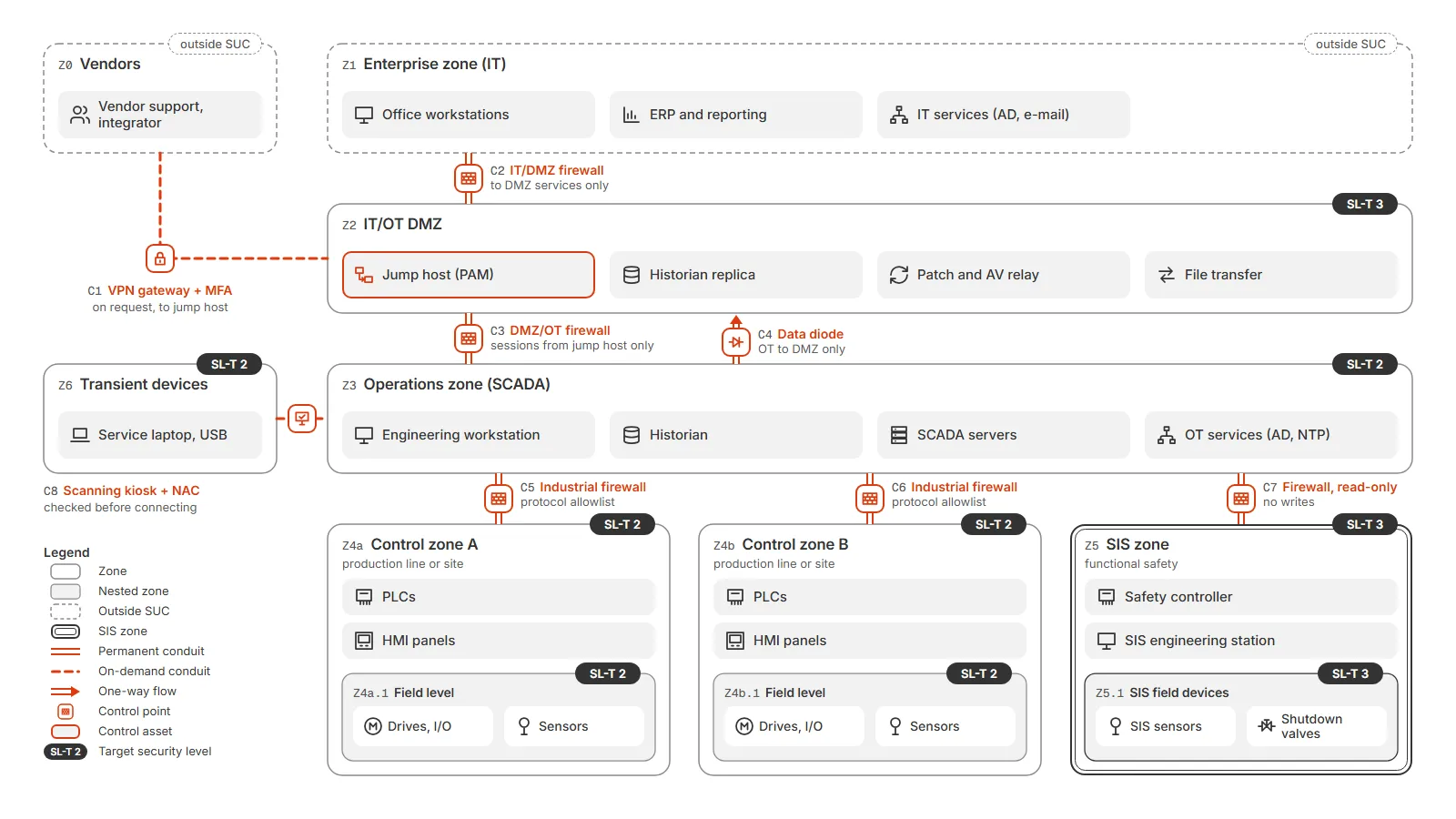
Which parts of IEC 62443 we audit for you
OT system operator
We audit the security programme (2-1), risk assessment with zones and conduits (3-2) and system requirements (3-3). The audit ends with an SL-A assessment against SL-T for every zone and conduit.
Component and system manufacturer
We audit the development process (4-1) and component technical requirements (4-2), and prepare you for assessment by an independent body, for example under ISASecure or IECEE CB.
If you do not need to demonstrate compliance yet and want to know the state of the network and its main risks, start with an OT security assessment.
If the network needs to be split into zones and there is no design for it yet, start with segmentation. Its documentation is the basis for the later SL-A assessment.
Who we serve
We've worked with national energy grid operators, systemically important banks, industrial automation manufacturers, renewable energy operators, and US DoD contractors.










Not sure this service fits your situation? Describe your environment and deadline in a few lines and we will propose a scope. We reply within one business day.
Frequently asked questions
How does IEC 62443 differ from NIS2?
NIS2 is a regulatory directive defining organisational obligations. IEC 62443 is a technical standard describing how to secure industrial automation systems. They are often used together - NIS2 requires risk management, and IEC 62443 provides the methodology.
Which parts of IEC 62443 apply to us?
It depends on your role. The operator, that is the asset owner of the OT system, runs a security programme under 2-1, assesses risk and divides the system into zones and conduits under 3-2, and requires system suppliers to meet the technical requirements of 3-3 at the SL-T. Integrators and service providers are covered by 2-4. Component manufacturers implement the development process under 4-1 and the component technical requirements under 4-2. We help determine the right scope.
What are zones and conduits?
A zone is a group of physical or logical assets set apart on the basis of risk or other criteria, such as function, location or responsible organisation; the assets in a zone share common security requirements. A conduit is a group of communication channels with common security requirements that connects two or more zones. Every zone and every conduit gets a target security level (SL-T).
How long does it take to reach IEC 62443 compliance?
A typical process takes 6 to 18 months, depending on system complexity and current security posture. An initial audit helps estimate the scope of work.
Do you need to visit the facility on-site?
Yes - zones and conduits assessment requires on-site verification of the network and physical architecture. Some analytical and documentation work is performed remotely.
What does the cost of an IEC 62443 audit depend on?
We count the days from the number of zones, conduits and automation systems and from the target SL-T: the higher the level, the more requirements to check. For a manufacturer, the assessment of the development process under 4-1 is added. The price is the estimated days times the daily rate, broken down by stage; we agree the scope on a free call.
Are audit results confidential?
Yes - we sign an NDA before work starts. The report belongs to you and we never share it without your consent. If your organisation is supervised under NIS2, the competent authority may request security documentation, so we write the report to be presentable as it is.
Related sectors, services and insights
Sectors
Services
- OT Security AssessmentWe show which paths lead to your controllers and what to fix first.
- NIS2 Compliance AuditWe establish whether NIS2 applies to you and which security measures are still missing.
- Cybersecurity TrainingEach group gets its own programme, and we measure the effect, e.g. with simulated phishing.
Articles
- Local administrator accounts in ICS - protection against pass-the-hash and credential theftProtecting local administrator accounts in ICS: LAPS, pass-the-hash, default HMI and PLC passwords, Active Directory hardening in OT. Checklist and IEC 62443-3-3 basis.
- OT and IT Security - Together or Separate?IT vs OT differences - priorities, technologies, lifecycle - and the answer to the question in the title: separate at the network layer, together in risk management and incident response.
- USB Removable Media Security in ICS Networks - Threats and ControlsUSB threats in OT environments - malware, sabotage, data exfiltration. IEC 62443 controls, security kiosk, and policies.
We'll discuss scope, methodology, and timeline.
Free consultation, no strings attached.