



Testing & Attack Simulation
We simulate real attacks so your team can sharpen its defences
Multi-vector adversary campaigns: social engineering, technical exploitation, physical access. We check whether your defence team, procedures and detection stop an attack that reproduces an adversary's methods, under control and mapped to MITRE ATT&CK. We base our work on the TIBER-EU methodology and help financial entities prepare for TLPT under DORA in case they are designated.
- 5
- 8+








Testing & Attack Simulation
- Social engineering campaigns (spear phishing, vishing, pretexting)
- Technical exploitation
- Physical access attempts to facilities and infrastructure
A penetration test shows which vulnerabilities can be exploited in the systems in scope. It does not answer whether the organisation would detect and stop a multi-stage attack that starts with an email to an employee and ends at the data or systems the adversary is after. Red teaming starts from the motivation and capabilities of a specific adversary, follows its attack paths and tests your defence in conditions close to the real thing.
Scope of the service
Social engineering campaigns (spear phishing, vishing, pretexting)
Technical exploitation - external and internal, including Active Directory and reaching the OT network boundary without actions in the control system
Physical access attempts to facilities and infrastructure
Testing Blue Team detection and response (SIEM, EDR, SOC)
Replay and purple teaming with the defence team after the attack: detected and undetected steps, root causes and alternative paths
Mapping techniques to MITRE ATT&CK
Red teaming based on the TIBER-EU methodology: threat intelligence-based scenarios, testing on production systems, the red team test report, replay and purple teaming
TLPT preparation - readiness assessment of the organisation, detection processes and Blue Team ahead of the test required under DORA
Controlled attacks on core banking systems, payment platforms and digital channels
A red team test report with content corresponding to Annex V of the DORA TLPT RTS, with a timeline and logs for the blue team test report, plus support with the test summary report and the remediation plan
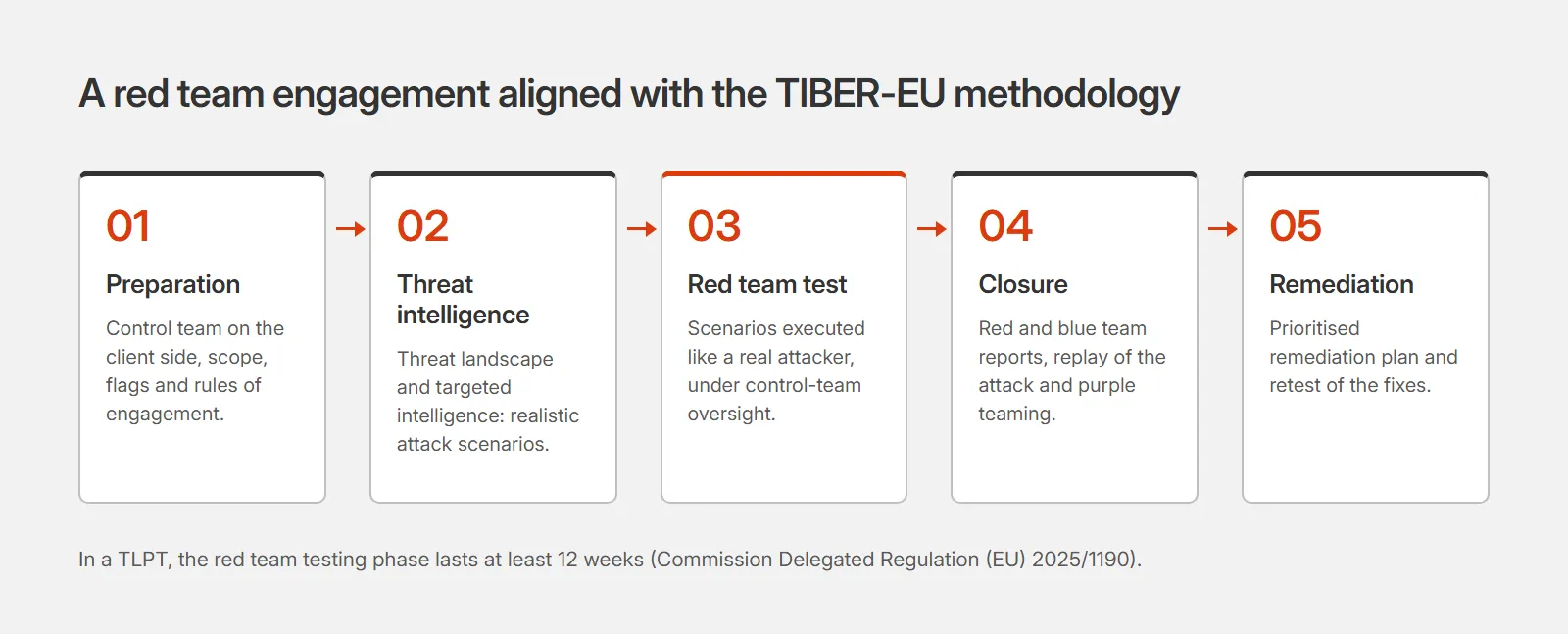
How we work, step by step
Preparation
With your control team we agree the test scope: critical or important functions, the systems that support them and the flags the testers have to reach. We also agree the rules that keep the test safe. Your defence team is not told about the test.
Threat intelligence
We base the attack scenarios on threat intelligence prepared for your organisation. It describes the adversaries relevant to you and proposes scenarios, from which the control team selects at least three. On that basis we prepare the test plan, which the control team approves.
Red team test
We run the test on production systems according to the scenarios and the plan: from reconnaissance, through initial access and movement across the network, to the flags. Every week we review progress with the control team.
Reports and replay
After the test we deliver the red team test report with each scenario's storyline in MITRE ATT&CK. Your defence team maps its observations against it, then we replay the attack together step by step and run a purple teaming exercise.
Remediation plan
After the replay and the exercise, all parties exchange feedback on how the test went. We then help you prepare the test summary report and the remediation plan: findings, root causes, priorities and owners.
Red teaming, penetration test or TLPT?
Choose a penetration test when you want to find as many vulnerabilities as possible in the systems in scope and get a fix for each one.
Red Teaming
Choose red teaming when basic security measures and a defence team are already in place and you want to see whether they detect and stop an attack run along several routes at once.
TLPT (DORA)
TLPT applies only to entities designated by the TLPT authority and is carried out by testers who meet the requirements of DORA Art. 27. Our red teaming based on the TIBER-EU methodology prepares you for such a test and does not replace it.
If you are not sure whether your institution is subject to TLPT, start with a DORA applicability assessment.
Who we serve
We've worked with national energy grid operators, systemically important banks, industrial automation manufacturers, renewable energy operators, and US DoD contractors.









Not sure this service fits your situation? Describe your environment and deadline in a few lines and we will propose a scope. We reply within one business day.
Frequently asked questions
What is the difference between vulnerability assessment, penetration testing, and red teaming?
A vulnerability assessment finds and catalogues technical flaws. A penetration test goes further: it exploits the vulnerabilities found to show what an attacker could achieve with them. Red teaming starts from a hypothesis about the adversary's motivation and capabilities, reproduces the whole attack from social engineering to reaching the target, and checks whether the defence team detects and stops it.
Which organisations benefit most from red teaming?
Red Teaming delivers the most value to organisations that already have basic security controls and a security team (SOC, Blue Team) - but need independent validation that these mechanisms work under the pressure of a real attack. We particularly recommend it for critical infrastructure operators, financial institutions, and organisations subject to DORA/TLPT regulations.
How long does a red team campaign take?
In a test aligned with the TIBER-EU methodology the active test alone lasts at least 12 weeks; with threat intelligence, the test plan and the closure phase the project usually takes more than six months. We also run shorter campaigns, for example for a single scenario. They are based on the TIBER-EU methodology, but because the active test is shorter than 12 weeks, they are not aligned with it.
Will my SOC/Blue Team know about the tests?
In a test aligned with the TIBER-EU methodology only the control team knows about it; the defence team is told after the active phase ends. Outside this methodology we can run a variant in which selected SOC staff know about the test. Both variants end with a replay of the attack with the defence team and a purple teaming exercise.
Do you test physical security as well?
Yes - the scope can include building entry attempts, device planting (USB drop, rogue AP), and tailgating.
Which techniques do you map?
We describe every technique used in MITRE ATT&CK notation and state the matrix version in the report. This lets you compare the result with your detection rules and with the next test.
What does the price of red teaming depend on?
The price is set by the number of attack scenarios, the length of the active test and the scope of the closure phase: replay, purple teaming and support with the remediation plan. We estimate the team's days for each phase, from preparation to the remediation plan, and multiply them by the daily rate. We agree scenarios and scope on a free call.
How does TLPT differ from standard penetration testing?
TLPT is a test on production systems carried out under the DORA TLPT RTS (Delegated Regulation 2025/1190, drafted in line with TIBER-EU): threat intelligence for the specific institution, at least 12 weeks of active red team testing and a closure phase with reports, replay and purple teaming. A penetration test has a narrower scope and looks for vulnerabilities in the systems in scope.
Does DORA require TLPT tests from every financial institution?
No. TLPT is performed by the entities that the TLPT authority identifies. The authority looks at the entity's impact, its systemic character and its ICT risk, including maturity (Article 2 of the RTS, Delegated Regulation 2025/1190). Systemically important banks (G-SIIs and O-SIIs) and the other categories listed in Article 2(2) perform TLPT unless the authority concludes that a test is not justified for them. We help you assess whether your organisation is likely to be identified.
How long does a full TLPT cycle take?
A typical TLPT cycle takes 9 to 12 months and often longer: it covers preparation and scoping, the Threat Intelligence phase, at least 12 weeks of active red team testing, and a closure phase with reports, replay and a purple teaming exercise.
Can your red teaming replace TLPT?
No. For entities designated by the supervisor, TLPT is performed by testers who meet the requirements of DORA Article 27, under the oversight of the TLPT authority. Our red teaming based on the TIBER-EU methodology lets you test your defences earlier and prepare, so the formal test holds no surprises.
Related sectors, services and insights
Sectors
- Banking and financeWe test a bank's digital channels and run red teaming aligned with the TIBER-EU methodology.
- EnergyWe check whether the operational network can be reached from the IT network or over VPN.
- DefenseWe combine CMMC and NIS2 requirements into a single work plan for your company.
- Manufacturing and industryWe secure older automation too, and plan tests together with your maintenance team.
Services
- Penetration TestingWe show what an attacker could achieve through the flaws, and retest after your fixes.
- DORA ComplianceWe build the register of information on ICT contracts and the major incident classification.
- Incident ReadinessYou get a response plan and playbooks tested with your team in a tabletop exercise.
Articles
- Password: password - why stolen credentials still open the door to systemsPassword security in IT and OT - NIST SP 800-63B guidelines, passkeys, default passwords on PLC/HMI, and a practical account protection checklist.
- Cyber Kill Chain - a model for analyzing cyberattacksLockheed Martin's Cyber Kill Chain - seven phases of a network intrusion. How to use the model for defense planning and how it relates to MITRE ATT&CK and the ICS Cyber Kill Chain.
- Industroyer2 - the unfinished attack on Ukraine's power gridIndustroyer2 (2022) - Sandworm malware targeting IEC 104, attempted attack on Ukrenergo neutralized by CERT-UA and ESET.
We'll discuss scope, methodology, and timeline.
Free consultation, no strings attached.