



OT & Critical Infrastructure Security
Dividing the OT network into zones and conduits in line with IEC 62443
We design the segmentation of the industrial network: we group assets into zones with common security requirements, set target SL-T levels and define the requirements for the conduits through which the zones communicate.
- 5
- 8+





OT & Critical Infrastructure Security
- Inventory of assets and data flows as the basis for the division
- Risk analysis and division of the system into zones and conduits according to IEC 62443-3-2
- A target security level (SL-T) for each zone and each conduit
An OT network in which controllers, operator stations and connections to the corporate network sit in one segment lets an intruder move between systems unchecked. IEC 62443-3-2 describes how to divide a system into zones and conduits based on a risk analysis. We go through this process with the automation team so that the segmentation can be implemented in the existing installation, within maintenance windows.
Scope of the service
Inventory of assets and data flows as the basis for the division
Risk analysis and division of the system into zones and conduits according to IEC 62443-3-2
A target security level (SL-T) for each zone and each conduit
Conduit requirements: permitted flows, firewalls, DMZ zones and remote access
A segmentation implementation plan agreed with the automation team and maintenance windows
Zone and conduit documentation (IEC 62443-3-2, ZCR 6) with the SL-A of the current state as the reference for the post-implementation assessment
How we work, step by step
Scoping
In a workshop with the client we set the system boundaries and the scope of the division.
Risk assessment and partitioning
We make an initial risk assessment of the system's functions, divide the assets into zones and conduits, compare the risk with the tolerable risk and set the SL-T of every zone and conduit.
Conduit design
For every conduit we record the channels (source, destination, protocol, port, direction, initiator) and choose the control point at the zone boundary.
Implementation plan
We set the order of changes so that production does not have to stop.
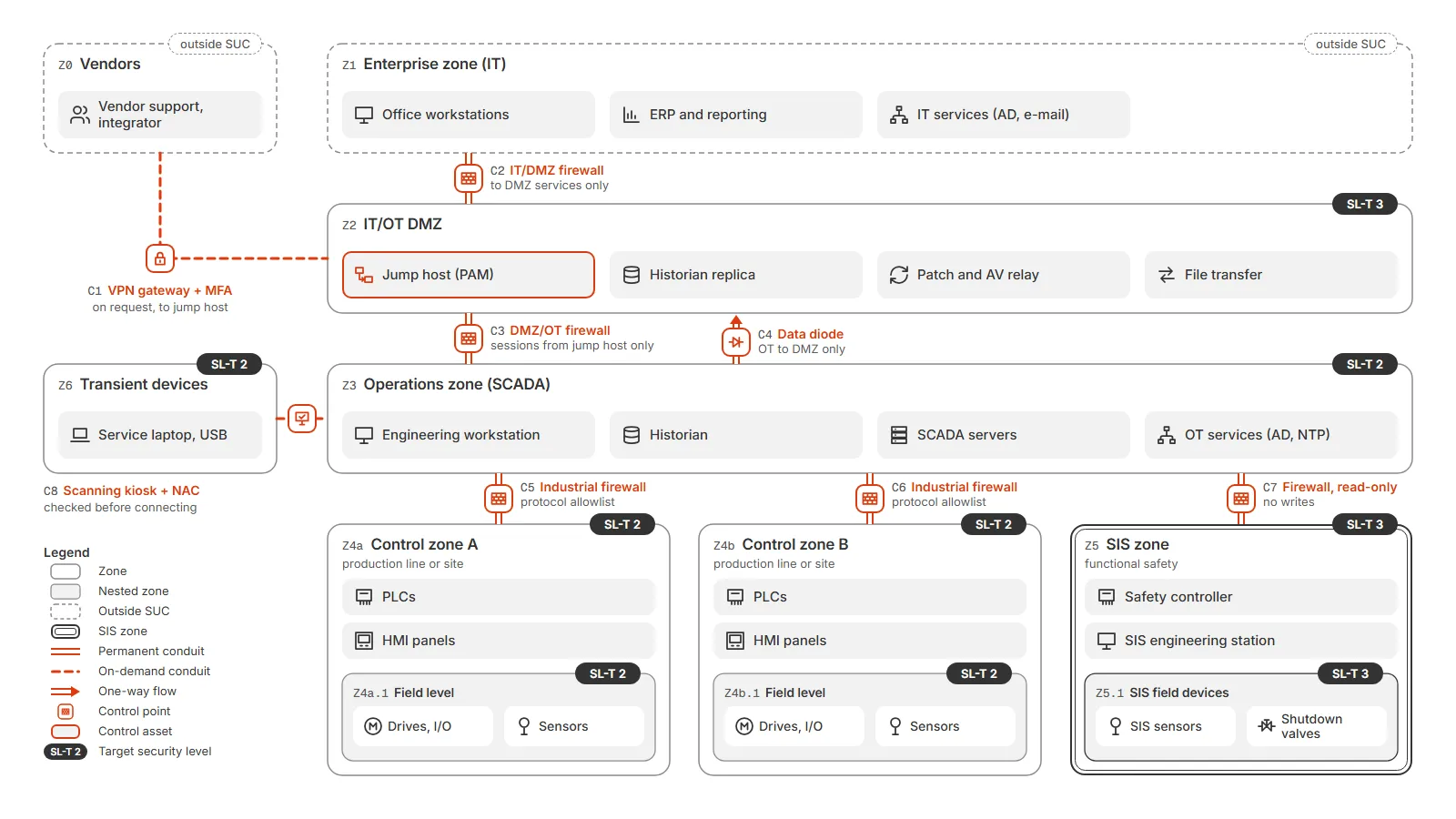
What the zones and conduits documentation contains
The project delivers the documentation your automation team uses to implement segmentation. It has five parts:
- System boundary
- In a workshop we agree which systems, sites and connections the project covers.
- Zones and conduits
- Each zone has its assets and each conduit its channels, and both have an SL-T derived from the risk assessment, with its justification.
- Channels and control points
- For every conduit we record the channels (source, destination, protocol, port, direction, initiator and justification) and the control point at the zone boundary: a firewall, a DMZ or a remote access gateway. The control point blocks traffic that is not on the list.
- Implementation plan
- We set the current state against the target concept with a list of differences, and agree the order of network changes with the automation team and the maintenance windows, so that production does not stop.
- SL-A of the current state
- The documentation contains the SL-A of the current state, established by checking the actual configuration. After the changes, the same checks show whether the controls reach SL-T.
Who we serve
We've worked with national energy grid operators, systemically important banks, industrial automation manufacturers, renewable energy operators, and US DoD contractors.










Not sure this service fits your situation? Describe your environment and deadline in a few lines and we will propose a scope. We reply within one business day.
Frequently asked questions
What are zones and conduits?
A zone is a group of physical or logical assets set apart on the basis of risk or other criteria, such as function, location or responsible organisation; the assets in a zone share common security requirements. A conduit is a group of communication channels with common security requirements that connects two or more zones. Every zone and every conduit gets a target security level (SL-T).
What is SL-T?
It is the target security level set from the risk assessment for every zone and every conduit, recorded as seven values, one for each foundational requirement (FR1-FR7). SL-A is assessed twice, for the current state and after the changes, and that assessment shows whether the controls reach the SL-T.
Does segmentation require stopping production?
We prepare the design passively, based on the inventory and traffic analysis. Network changes are planned with the automation team within maintenance windows.
Do you need to visit the plant?
Yes. Verifying the network and physical architecture requires work on site. Part of the analysis and documentation is done remotely.
What does the cost of a segmentation project depend on?
The cost depends on the number of automation systems, sites and zones to design, and on whether an up-to-date inventory exists, because without one it has to be built first. We count the days for each stage, from the scoping workshop to the implementation plan, and multiply them by the daily rate. We agree the scope on a free call.
Related sectors, services and insights
Sectors
Services
- IEC 62443 AuditWe establish the SL-A your zones and conduits achieve and what separates it from the SL-T.
- OT Security AssessmentWe show which paths lead to your controllers and what to fix first.
- Security ArchitectA senior expert reviews your projects and change requests within a monthly pool of hours.
Articles
- Defense in Depth in Distributed Control Systems (DCS) - the network layer step by stepThe network layer of defense in depth for a DCS: zones and conduits based on risk assessment, SL-T, firewalls between adjacent levels, the DMZ decision and microsegmentation.
- Zero Trust Architecture - how to introduce the NIST SP 800-207 model in IT and OTZero trust under NIST SP 800-207 step by step: seven tenets, PE, PA and PEP, four deployment models, the CISA maturity assessment and the limits of use in OT networks.
We'll discuss scope, methodology, and timeline.
Free consultation, no strings attached.